Model Focus Environmental Citizenship
Environmental citizenship is the responsible pro‐environmental behavior of citizens who act and participate in society as agents of change in the private and public sphere, on a local, national and global scale, through individual and collective actions, in the direction of solving contemporary environmental problems, preventing the creation of new environmental problems, achieving sustainability, as well as developing a healthy relationship with nature.
(ENEC 2018)
The model blow demonstrates a base line understanding about how we can incorporate education for environmental citizenship. This includes citizenship education, environmental education, science education and education for sustainable development. Depending on the grade and students in the classroom this model can be used throughout the year and to develop the different ways to teach science and other course work.
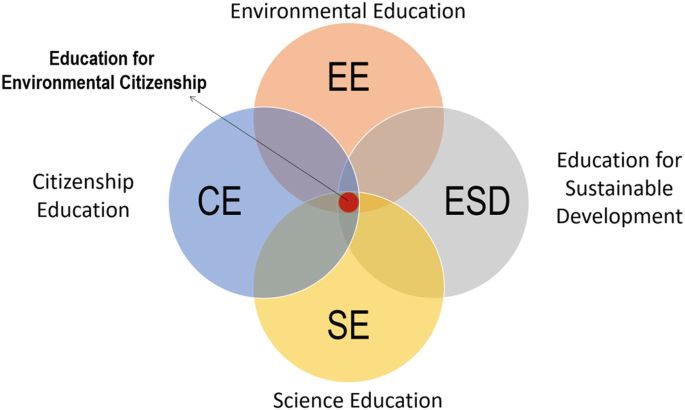
The next model is the different ways to develop your understanding with education for environmental citizenship. This is for a younger audience that can focus on the different models first rather than the base line types of education.
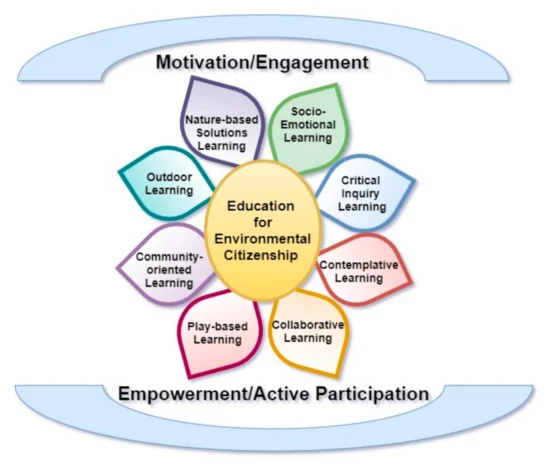
This model helps explain the different types of learning and education you could bring into your classroom. For example, play based learning is where children learn through play while developing social skills and fine motor skills by playing with other children and communicating through play. This helps social regulation with the younger age group. Older age groups can interact this this as well. Ther can be more guidance or structure for them to involve more school subjects in the objective of play based leaning for them, but they still need to free play and interact without the worry of being graded. This form of learning can also connect through there science and language arts class. A way to do that is by reading outside, connecting a book concept to outdoor learning.
Extensions of Learning
To extend on the topic there are great podcasts to learn about environmental citizenship. One podcast you can listen too with an intermediate grade level is 1point 5. It is a podcast for the Generation Z and to talk about climate justice. https://akidsco.com/pages/1-point-5
Another podcast to listen to and connect learning science is Smologies. This podcast is a kid friendly podcast that goes into depth about science related topics. https://www.alieward.com/smologies
Subject Focus Language Arts.
How to connect these topics with language arts is to expand on the topic of environmental citizenship and environmental justice for primary education. This can be listening to a podcast about pumpkins and find a book about pumpkins and relate it to a food chain or composting.